

By, OurWorldGistNews
Political commentator and public affairs analyst, Dr Sam Omale, has challenged the All Progressives Congress (APC) to account for its performance in government before seeking another mandate from Nigerians, describing its 2027–2031 manifesto as another collection of promises that must be measured against its record of delivery.
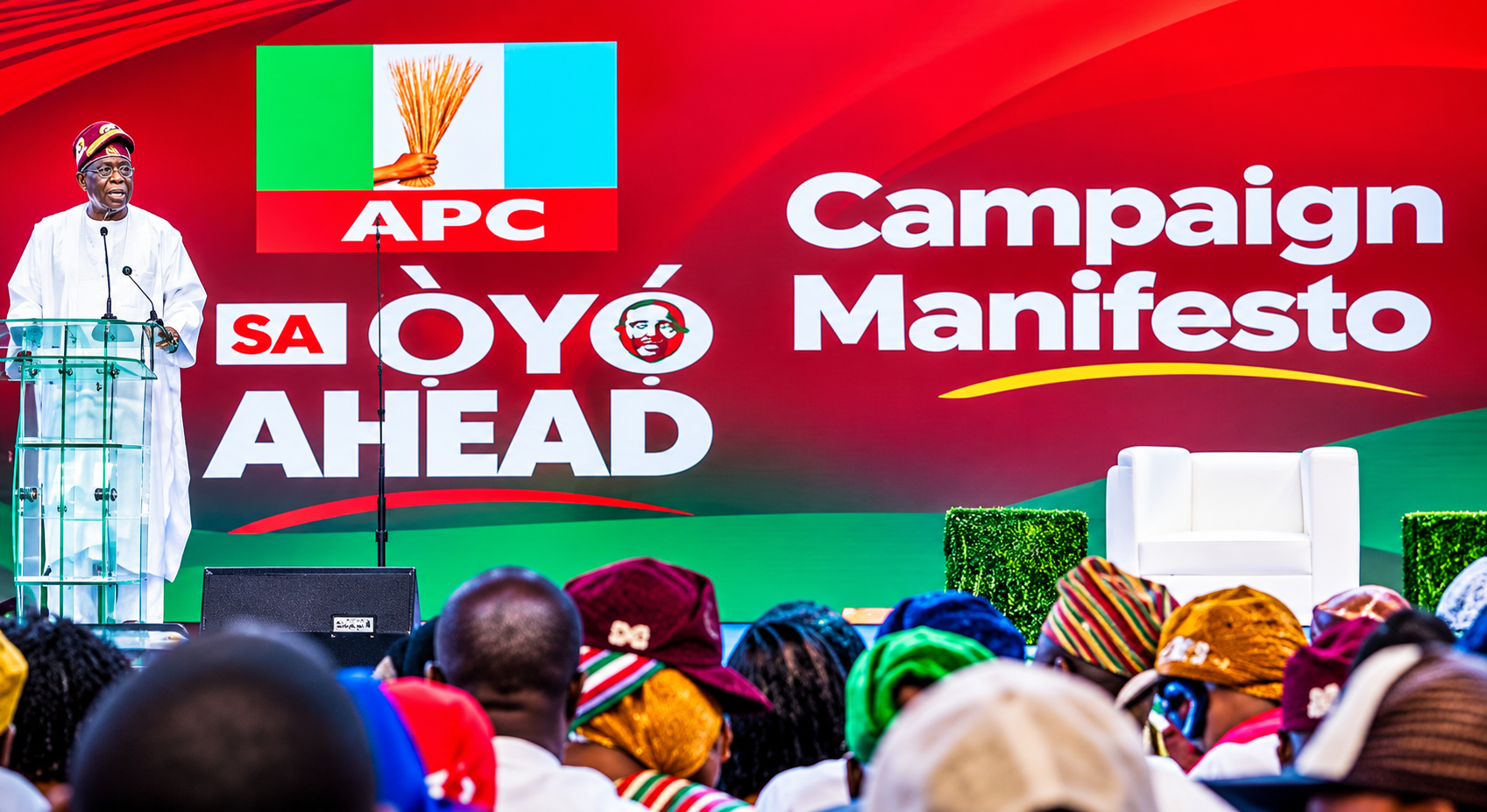
Reacting to the party’s 109-page manifesto titled From Reforms to Prosperity Agenda 2027–2031, Dr Omale argued that Nigerians should not be carried away by ambitious projections when previous promises have yet to translate into tangible improvements in their lives.
The manifesto, built around national security, improved living standards, infrastructure-led economic growth and accountable governance, promises six per cent annual economic growth, reduced youth unemployment and inflation, expanded electricity generation, increased security personnel and 200,000 affordable housing units.
However, Dr Omale questioned the credibility of these commitments, insisting that the central issue is not what the ruling party intends to achieve but what it has accomplished since assuming power in 2015.
He recalled that the APC had promised to tackle insecurity and corruption but argued that both challenges remain major national concerns. Citing Adams Oshiomhole’s controversial remark that all sins are forgiven once someone joins the APC, he questioned the sincerity of the party’s anti-corruption campaign.
He also recalled President Bola Tinubu’s campaign pledge on electricity: “If I do not give you electricity, do not vote for me.” According to him, Nigerians are still struggling with inadequate electricity supply, yet the administration is asking for another mandate.
On the economy, Dr Omale described the projected six per cent annual growth as ambitious, questioning the feasibility of reducing inflation to eight per cent or below while households continue to battle high food prices and declining purchasing power. Although headline inflation moderated to 14.63 per cent in September 2026, food inflation remained at 19.59 per cent, highlighting the continuing pressure on household budgets.
He equally questioned the feasibility of expanding electricity generation to 7,500 megawatts, with a 10,000-megawatt peak target, and deploying seven million electricity meters, insisting that Nigerians deserve evidence of implementation rather than another round of promises.
On security, he expressed reservations about the proposed recruitment of 28,000 military personnel and 50,000 police officers, as well as the pledge to halve the number of out-of-school children.
He also questioned the commitment to expand health insurance coverage to 40 per cent of the population and construct 200,000 affordable homes, demanding clarity on their funding and implementation.
“A government that has struggled to demonstrate sufficient progress in addressing these fundamental challenges cannot simply announce ambitious targets and expect Nigerians to accept them without scrutiny. Where is the implementation record?” he asked.
Dr Omale further accused the APC of shifting attention from the economic hardship associated with its first-term reforms to anticipated benefits in a possible second term.
He observed that the manifesto offers limited clarity on immediate household relief, real wage growth, food affordability and poverty reduction.
He also noted that several delivery targets are concentrated towards 2030 and 2031, raising questions about whether Nigerians will see meaningful results early enough to assess the administration’s performance.
Identifying a disconnect between macroeconomic projections and the realities of ordinary Nigerians, he maintained that improved economic indicators mean little to families struggling to afford food, housing, healthcare and other basic necessities.
“One must be cautious about a manifesto that promises prosperity without first providing an honest account of the pain Nigerians have endured and the results already delivered. A blueprint is only as credible as the track record behind it.
“If the government could not adequately address these challenges within its first tenure, Nigerians are entitled to ask what will be fundamentally different in the next four years. As Wike would say, ‘If it didn’t de, it didn’t de.'”
Dr Omale stressed that political parties must be assessed by their records rather than the sophistication of their campaign documents, adding that the 2027 election presents Nigerians with an opportunity to demand accountability, transparency and verifiable results.
Concluding, he invoked the Latin legal maxim, Nemo dat quod non habet, meaning that no one can give what they do not have, insisting that leadership must be measured by execution, not promises.
“Nigerians need performance, not repackaged promises. Before asking for another mandate, the APC must account for the promises of yesterday and demonstrate why its promises of tomorrow should be believed,” he declared.
