

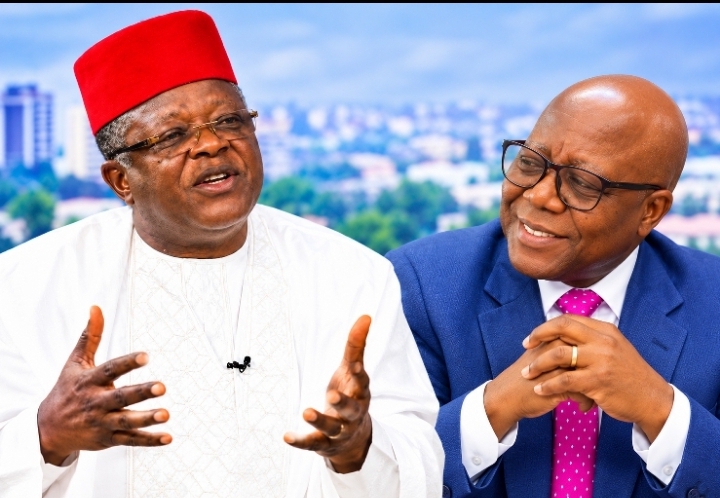
David Umahi, Nigeria’s Minister of Works and Professor of Practice, represents the contradictions, political opportunism and personal ambition that continue to undermine principled leadership in Nigerian politics.
His political trajectory raises critical questions about consistency, regional solidarity and the sacrifices politicians are willing to make for personal advancement.
Following his unsuccessful bid for the All Progressives Congress (APC) presidential ticket, Umahi openly lamented the marginalisation of the South-East and accused Igbo political leaders of betraying their people. He declared: “He that betrays his brother or sister, even the buyers will never trust him or her. It is a big shame.”
Although a powerful indictment of political disloyalty, the statement invites an uncomfortable question: has Umahi remained faithful to the principles he so passionately defended, or have his subsequent political choices contradicted his earlier convictions?
Umahi highlighted the South-East’s longstanding grievances within Nigeria’s federal structure, particularly the disparity in state creation.
While the South-East has five states, other geopolitical zones have six or seven. He also questioned the imbalance in local government distribution, which affects political representation, administrative reach and the allocation of certain public resources.
These concerns reflect broader demands for equity, federal character and meaningful inclusion. For many people in the South-East, the issue transcends numbers; it concerns equal recognition, fair representation and a genuine sense of belonging within the Nigerian state.
Yet, the controversy lies in the apparent contradiction between Umahi’s denunciation of regional marginalisation and his subsequent political alignment with the national power structure under President Bola Ahmed Tinubu.
Critics question whether his earlier declarations represented a sustained commitment to regional justice or the frustration of an ambitious politician whose presidential aspirations had been thwarted.
His recollection that he “wept internally and externally” over the conduct of delegates and regional leaders during the presidential primaries conveyed profound disappointment.
However, the circumstances surrounding those remarks make it legitimate to ask whether his anguish was rooted in collective interest or personal political disappointment.
Umahi reportedly urged South-East leaders to support any presidential aspirant from the region, arguing that such unity would demonstrate the zone’s political resolve.
He also condemned delegates accused of compromising their votes during the primaries. Against this background, his subsequent political choices have fuelled criticism among those who believe regional solidarity should not be sacrificed at the altar of individual ambition.
The irony is striking: a politician who warned that betrayal destroys trust must now contend with questions about whether his own decisions have weakened the confidence of those who once regarded him as a champion of regional interests.
To be clear, political alliances are legitimate in a democracy, and participation in a federal administration does not automatically amount to betrayal. Umahi’s supporters could reasonably argue that his position in government offers an opportunity to influence national policy and attract infrastructure development to the South-East.
That argument deserves consideration, but it must ultimately be tested against his performance, demonstrable results and commitment to the region’s legitimate demands.
The real issue, therefore, is not whether Umahi should cooperate with the Federal Government, but whether such cooperation advances the collective interests he once so forcefully articulated.
Political appointments and proximity to power cannot, by themselves, resolve longstanding questions of marginalisation, representation and accountability.
Ultimately, leadership is measured not by the intensity of one’s rhetoric in moments of disappointment, but by the consistency of one’s principles when power and political rewards become available.
If the grievances Umahi identified were genuine, they should remain relevant regardless of who occupies the presidency or which party controls the Federal Government.
This debate extends beyond Umahi to other Igbo political leaders whose choices have attracted accusations of prioritising personal interests over collective aspirations.
Their responsibility is not necessarily to oppose every administration, but to ensure that political cooperation delivers tangible benefits without abandoning legitimate regional demands.
For a region seeking greater inclusion, the challenge is to produce leaders capable of negotiating constructively with the centre while remaining accountable to their people.
Otherwise, the language of marginalisation risks becoming a bargaining instrument for political appointments rather than a principled demand for justice.
Umahi’s warning about betrayal has therefore returned as a test of his own political credibility. Can a leader convincingly condemn the abandonment of collective interests while facing sustained criticism over the direction of his political choices?
Until that question is answered through consistent action, transparent engagement and demonstrable commitment to regional equity, the controversy will remain a compelling illustration of the contradictions in Nigerian politics.
Power may secure a seat at the table, but only integrity, consistency and an unwavering commitment to the people can earn a leader their lasting trust.
The Opinion expressed here is that of Dr Sam Omale, He a Theocract, a Nigerian Politician, a Financial Expert who comments on both Local and National Issues.
