

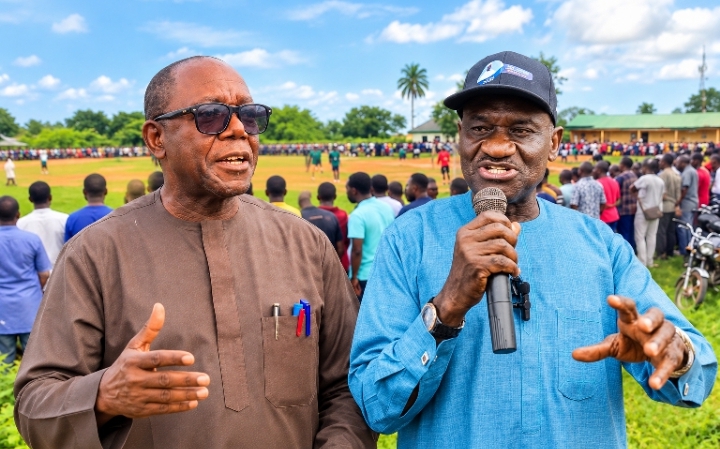
Over 3,000 enthusiastic spectators on Saturday last week thronged a football pitch in Ejule, Kogi State, to witness an enthralling community football encounter between Akanya and Ofe’uloko Football Clubs, in a display that underscored the unifying power of sports.
The match attracted the attention of Admiral Usman Jibrin, popularly known as Akpabana, and Sam Omale, who were returning from Idah after attending the Ukomu Igala Truth and Reconciliation Summit when they encountered the massive crowd.
Unable to ignore the spectacle, the duo stopped to join the gathering and witnessed what they described as an impressive demonstration of grassroots football talent, community spirit and youthful energy.
The spectators, numbering more than 3,000, stood, squatted and cheered passionately as players from the two Ejule-based clubs battled for supremacy in a keenly contested encounter.
Despite the poor condition of the playing field, characterised by a hard, dry and uneven surface surrounded by overgrown grass, the young footballers demonstrated remarkable commitment and skill, entertaining the large crowd throughout the encounter.
The gathering also provided a striking picture of community solidarity in a town that has, over the years, faced concerns over insecurity and youth-related violence.
The atmosphere at the match was described as one of excitement, unity and camaraderie, with residents from different backgrounds coming together to support their respective teams.
The visitors expressed delight at witnessing the event, noting that grassroots sporting activities could provide a powerful avenue for healing, youth engagement, social cohesion and economic development in communities affected by insecurity and poverty.
They, however, lamented what they described as the failure to adequately harness the economic and social potential of sports in Kogi State, particularly at the grassroots level.
According to them, rather than providing sustainable platforms for young people to develop their talents, successive political interests often risk exploiting the energy of youths for political purposes.
At the time of their departure, neither Akanya nor Ofe’uloko had found the back of the net, but the quality of entertainment and enthusiasm generated by the encounter had already made the event memorable.
The visitors subsequently assured the organisers and players of their commitment to supporting grassroots football and youth empowerment in Ejule, promising that the community would receive further attention and patronage.
They commended Mr Musa Seidu for organising the tournament and pledged to support his efforts to sustain and expand the initiative.
Special appreciation was also extended to Admiral Usman Jibrin for his continued support for initiatives that promote the welfare and development of his people.
The visitors maintained that the experience in Ejule demonstrated that Kogi State possesses abundant human and sporting potential capable of contributing significantly to socio-economic development if properly harnessed.
They called for greater unity of purpose and deliberate investment in grassroots sports, youth development and community-based initiatives, stressing that such efforts could transform untapped talents into productive ventures and create new opportunities for the people.
“Kogi State of our dreams is possible,” they declared, expressing optimism that collective commitment and purposeful leadership could help build a more peaceful and prosperous society.
As the spectators dispersed after the encounter, the football match had delivered more than sport it had provided a rare moment of unity, hope and collective celebration for the people of Ejule.
