

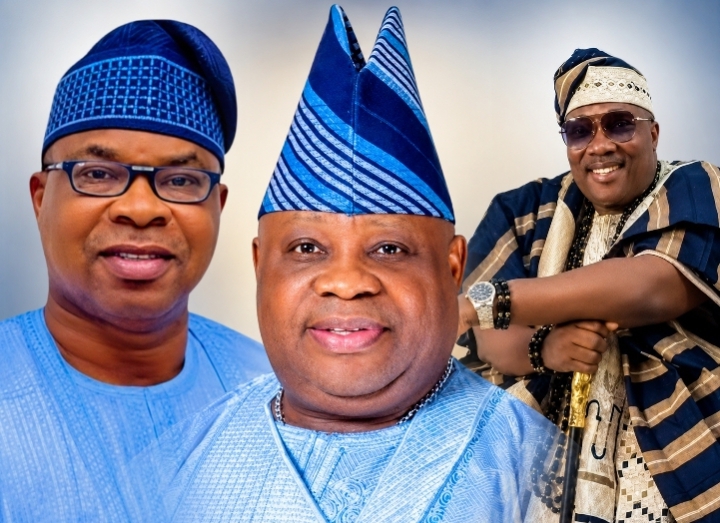
Osun State has spoken, and its voice has echoed far beyond the boundaries of the state.
In one of the most keenly watched governorship contests in recent memory, Governor Ademola Adeleke of the Accord Party has emerged victorious, polling 511,067 votes to defeat the candidate of the All Progressives Congress, Bola Oyebamiji, who scored 444,815 votes.
The African Democratic Congress candidate, Najeem Salaam, trailed in third place.
This outcome, announced after a tense and closely monitored collation process, has been described by many observers as nothing short of the triumph of ordinary people over the machinery of political power.
What makes this victory remarkable is not simply the number attached to it, but the road that led to it. Before the votes were cast, Adeleke found himself stripped of the very structures that typically shield an incumbent.
He lost control of local government governance structures across Osun State and, with it, access to local government funds that usually sustain grassroots political networks.
At a point, he was effectively locked out of joining the ruling party, and there were moments when he was described as politically homeless, without a party platform to stand on as the contest drew near.
The pressure did not end there. Reports emerged that the Economic and Financial Crimes Commission moved to freeze accounts linked to his allies before the intervention of the presidency became public knowledge.
To many in Osun and beyond, this sequence of events looked less like routine oversight and more like a coordinated attempt to weaken a sitting governor ahead of an election.
Yet through all of this, the resolve of the Osun electorate did not waver.
There is a broader story here about power and its limits. Sixteen governors under the All Progressives Congress banner, alongside the Senate President and a sizeable entourage, reportedly moved into Osun to rally support against Adeleke.
Former governors of the state, cutting across different eras and parties, also aligned against him.
On paper, this looked like an insurmountable wall of political weight bearing down on one man.
Yet the people of Osun, ward by ward and polling unit by polling unit, delivered a verdict that no amount of gathered political muscle could overturn.
Questions have also been raised about the conduct of the process itself, with concerns voiced in some quarters that the collation system experienced disruptions during the count, disruptions that fueled suspicion among Adeleke’s supporters that an attempt was being made to alter the trajectory of the results.
Whatever the merit of those concerns, the final figures declared by the Independent National Electoral Commission stood in Adeleke’s favour, and Osun’s decision held firm.
Beyond the borders of the state, attention was drawn by the sustained public advocacy of the Grammy winning musician Davido, whose consistent calls for vigilance and his appeals to international observers to monitor the process kept a global spotlight on Osun throughout the exercise.
That visibility, many believe, made it harder for any irregularity to pass unnoticed, and it placed additional scrutiny on utterances from political figures such as the Edo State Governor, Monday Okpebolo, whose comments during the period drew wide criticism.
For Governor Gboyega Oyetola, the outcome leaves considerable explaining to do before President Bola Ahmed Tinubu, given the scale of political and institutional resources reportedly deployed in Osun State to secure a different result.
The gap between that effort and the eventual outcome has become a subject of intense discussion within party circles.
At its core, this election offers a lesson that transcends Osun State politics.
Power, however concentrated, does not always bend to those who wield it.
A man who was without a governing structure, without full party backing, and reportedly without unimpeded access to funds still stood before the people of Osun and earned their mandate.
For many watching, this is a reminder that authority ultimately rests with the electorate, not with those who attempt to manufacture outcomes on their behalf.
As Osun State moves forward from this election, the path ahead calls for restraint and maturity from all sides.
The All Progressives Congress and its supporters, having contested vigorously and lost, would do well to allow the democratic process to stand.
Nigeria’s democracy grows stronger each time a result, however inconvenient to those in power, is respected rather than resisted.
Osun has decided, and that decision deserves the dignity of acceptance.
Sani Michael Omakoji
A Public Affairs Commentator on Both National &: Trending Issues
